
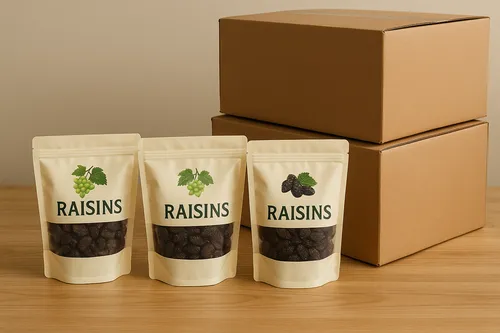
Why many importers start with bulk shipments
Bulk raisins deliver the most cost-effective way to build a product line. Suppliers pack raisins in 10–12.5 kg poly-lined cartons, which importers then repack locally to control:
- Retail packaging cost
- Local branding and labeling
- Format variety such as 200g, 500g or 1kg pouches
- Freshness perception through just-in-time packing
This model is especially popular for private-label and mid-priced raisin segments.
Choosing the right raisin grade for consumer packs
Visual quality is critical in consumer packs. The better the colour and uniformity, the stronger the product’s retail presence. For this reason, most brands select:
- No. 9 (light) for premium retail lines
- No. 8 (medium) for mainstream supermarket SKUs
- No. 7 (dark) only when price is the dominant factor
Importers should also specify moisture level, since too much moisture can cause clumping inside packs, while overly dry raisins appear aged.
Retail packaging formats and where they fit
Stand-up pouches (most common)
Flexible pouches dominate retail due to convenience, low weight, good branding area and competitive cost. They are ideal for 200–500g formats.
Rigid boxes
Often used in family-size packs or premium lines. They provide sturdy shelf presence but cost more.
Mini-snack packs (10g–40g)
Popular for lunchboxes, airline catering or portion-controlled retail lines. Packing efficiency becomes important in this format.
Moisture, oiling and de-clumping considerations
When transitioning from bulk to consumer packs, buyers should manage:
- Oiling — typically 0.3–0.5% vegetable oil for flowability
- Moisture range — usually 13–16% for retail-ready raisins
- Softness consistency — required for strong repeat purchases
Raisins with excessive stickiness may need additional air drying or re-sieving before packing.
Pricing and margin planning
Moving from bulk to retail requires calculating costs beyond raw material:
- Pouch or box cost
- Labour or co-packing fee
- Loss factor during packing (0.5–1.5%)
- Logistics from warehouse to retail
- Retailer margin expectations
Many brands define their retail pricing first, then reverse-engineer what grade and packing format fit the target margin structure.
Summary for importers and packers
Transforming bulk raisins into consumer-ready SKUs requires aligning colour, moisture, format and pricing from the beginning. By choosing the right grade and defining packing parameters clearly, brands build consistent products that resonate with shoppers and meet retailer performance expectations.
Atlas supports customers with grade selection, technical specifications and mixed-container planning for all raisin-based retail lines.